Dayton Engineering
Sciences Symposium

Keynote
Dr. Timothy Buning
Advanced Materials including Liquid Crystal Thin Film Optical Elements
Engineering and Computer Science,
Wright State University
The ecosystem around advanced material development needed for the military is under constant tension as performance needs shift. This talk will use examples from Hollywood to generically discuss some of the future material challenges for both structural and functional applications. The talk will end with focused research on optical thin films fabricated from mixtures of polymer and liquid crystal, having useful numerous optical applications in complex optical systems, particularly as an enabler to minimize size and weight of bulky refractive optical trains in a variety of dynamic and static optical applications. The work was done in collaboration with a small company in Florida called BEAM, Inc. The talk will explore using light to pattern substrate surfaces and subsequent polymerization to enable thin, monolithic, transparent films. Examples of switchable lenses, dynamic beam steering, and switchable diffractive waveplates, among others will be shown.
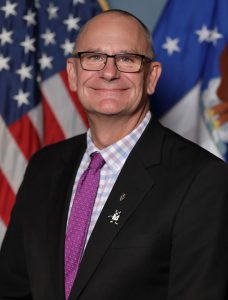
Timothy J. Bunning is the interim dean of the Wright State University College of Engineering and Computer Science. Dr. Bunning retired last year after a distinguished 35-year career at the Air Force Research Laboratory at Wright-Patterson Air Force Base. Most recently, he served as chief technology officer, the primary science and engineering adviser to the AFRL commander, overseeing an annual $3.5 billion science and technology program and a workforce of nearly 6,000 people across nine technology directorates and the 711th Human Performance Wing. He previously served as chief scientist of the Materials and Manufacturing Directorate.
Throughout his career, Dr. Bunning has earned numerous prestigious
awards for his work. Notably, he received the Arthur S. Flemming
Award, a top distinction for federal engineers and scientists, and
he was recently inducted into the National Academy of Engineering -
among the highest professional distinctions accorded to an engineer.
He earned his doctorate, master's degree and bachelor's degree in
chemical engineering from the University of Connecticut and
conducted his Ph.D. research in the AFRL labs.